Find keratoconus care near you.
Search source-checked U.S. offices by location and service.
New to keratoconus? Explore the free Starter Kit


Free Starter Kit
A clearer next step, in 10 pages.
A guide to read at your own pace, for adults, young people and the families who help them.
Free, no account or email needed.


Inside: your diagnosis, care options, and support for families.
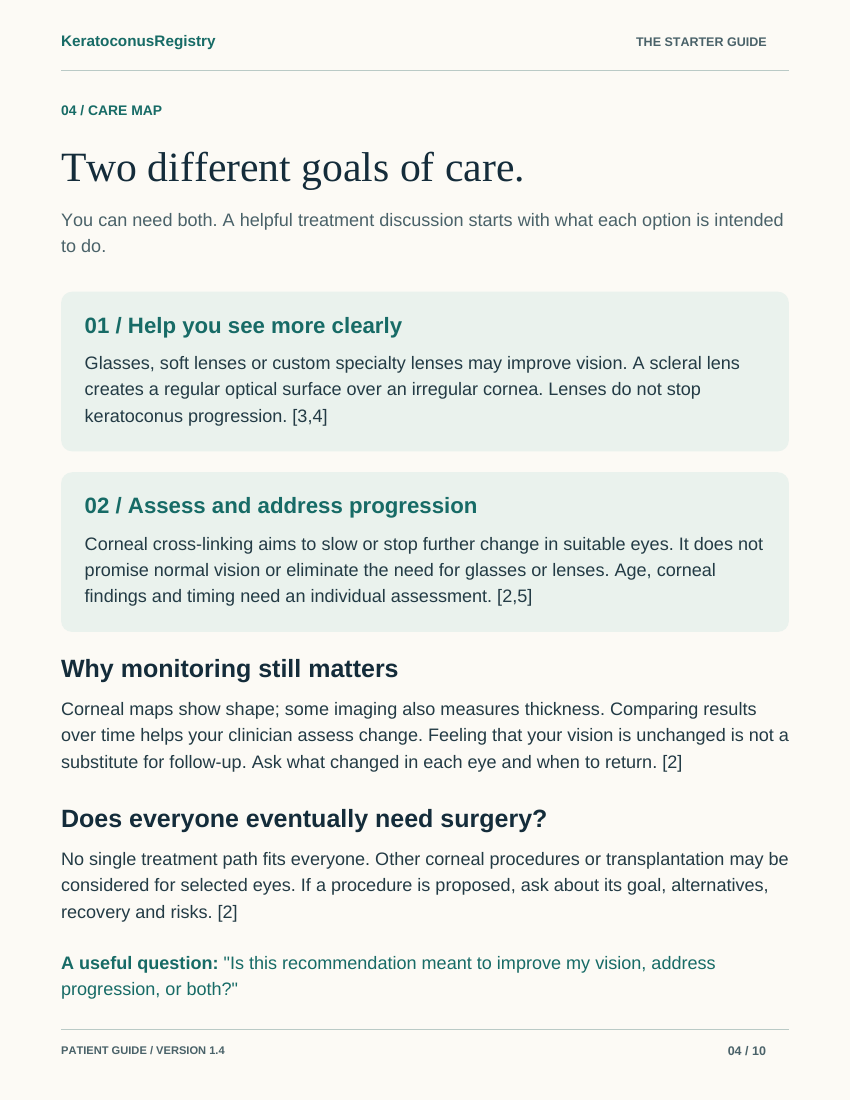
- Understand the diagnosisWhat keratoconus changes, and why seeing more clearly and checking progression are two distinct goals of care.
- Prepare for care conversationsWhat lens fittings involve, which costs to ask about, and one optional appointment checklist.
- Plan for children and familiesA page for parents, caregivers and young people on monitoring, eye rubbing and a child's own voice.
PDF, 10 pages · about 1.46 MB. Clinically reviewed and approved October 22, 2026.

Patient guides
Start with what you need today.
Plain-language guides for adults, teens, children and the families who help them, each with its sources listed.
14 patient guides · Text clinically reviewed October 21, 2026
- Seeing more clearlyGlasses or lenses, for usable daily vision at school, work and home
- Watching for changeRepeat scans compared with your baseline; each eye judged on its own
Two separate paths that can run side by side. Your plan may use one or both, and not every cornea changes.
New diagnosis
Newly diagnosed with keratoconus
What the diagnosis means, what your first scans are for, and the two goals of care.
Read the guide: Newly diagnosed with keratoconus- 01KeratometryA few points on the central front surface
- 02TopographyThe whole front surface, seen face on
- 03TomographyFront and back surfaces, plus the thickness between
Conceptual drawings, not patient scans and not to scale. Change is judged by comparing reliable repeat scans, and your clinician interprets them.
Scans and progression
Understanding corneal maps and progression
What each type of corneal scan measures, what makes repeat scans comparable, and why one color or number does not decide anything.
Read the guide: Understanding corneal maps and progressionShared individual plan
- Child: How things look and feel; what is hard at school or play
- Caregiver: Patterns over weeks, such as squinting, rubbing or tiredness
- Clinician: Exam findings and repeat scans compared over time
Each voice adds something the others cannot see. Circle sizes are illustrative.
Children, teens and families
Keratoconus in children and teens: a guide for families
Understand pediatric assessment, monitoring, treatment questions and the everyday support a child or teen may need.
Read the guide: Keratoconus in children and teens: a guide for families
Before your appointment
Quick, careful answers.
What is keratoconus?
A condition where the cornea, the clear front of the eye, thins and changes shape. That shape change can blur or distort vision.
How is it diagnosed?
Through an eye exam, usually with corneal imaging. Symptoms alone cannot confirm it, so an exam is the right next step if you have concerns.
Do scleral lenses stop it from getting worse?
No. Specialty lenses, including scleral lenses, may help you see more clearly, but they do not stop progression.
What is cross-linking for?
It is intended to slow or stop progression when appropriate. It is not a cure and does not usually remove the need for glasses or contacts. Your clinician decides whether it suits you.
General education only, not personal medical advice. Learn more and see sources
Where our answers come from
- American Optometric Association(opens in a new tab)
- Scleral Lens Education Society(opens in a new tab)
- American Academy of Ophthalmology(opens in a new tab)
View all 41 sources
All sources
- American Academy of Ophthalmology: What is keratoconus?(opens in a new tab)
https://www.aao.org/eye-health/diseases/what-is-keratoconus
- National Eye Institute: Other types of contact lenses(opens in a new tab)
https://www.nei.nih.gov/eye-health-information/healthy-vision/contact-lenses/other-types-contact-lenses
- National Eye Institute: Research on corneal conditions(opens in a new tab)
https://www.nei.nih.gov/eye-health-information/eye-conditions-and-diseases/corneal-conditions/research-corneal-conditions
- Mayo Clinic: Keratoconus: diagnosis and treatment(opens in a new tab)
https://www.mayoclinic.org/diseases-conditions/keratoconus/diagnosis-treatment/drc-20351357
- OHSU Casey Eye Institute: Corneal cross-linking(opens in a new tab)
https://www.ohsu.edu/casey-eye-institute/corneal-cross-linking
- American Optometric Association: Keratoconus(opens in a new tab)
Patient overview: diagnosis, glasses or soft lenses early on, carefully fitted rigid lenses, follow-up and treatment.
https://www.aoa.org/healthy-eyes/eye-and-vision-conditions/keratoconus
- Scleral Lens Education Society: What are scleral lenses?(opens in a new tab)
Scleral lenses are fitted individually, with measurements, adjustments and ongoing check-ups.
https://sclerallens.org/for-patients-2/what-are-scleral-lenses/
- Scleral Lens Education Society: Patient resources(opens in a new tab)
More patient information about wearing and caring for scleral lenses.
https://sclerallens.org/for-patients-2/
- Kreps EO, Pesudovs K, Claerhout I, Koppen C. Cornea. 2021;40(7):859-864 (PubMed): Mini-scleral lenses improve vision-related quality of life in keratoconus(opens in a new tab)
Research study of people with keratoconus: vision and daily function improved for many who kept wearing the lenses; some stopped, mostly because of handling difficulties. It did not test whether lenses slow the disease.
https://pubmed.ncbi.nlm.nih.gov/32947413/
- Mayo Clinic: Keratoconus: symptoms and causes(opens in a new tab)
Symptoms including glare and night-driving difficulty, risk factors, and sudden worsening as a reason to see an eye doctor.
https://www.mayoclinic.org/diseases-conditions/keratoconus/symptoms-causes/syc-20351352
- Scleral Lens Education Society: Lens handling FAQs(opens in a new tab)
Nightly cleaning, preservative-free filling, no tap water, bubbles, fogging causes, no sleeping in lenses, removal tips.
https://sclerallens.org/for-patients-2/patient-faqs/
- Scleral Lens Education Society: Scleral lens care guide(opens in a new tab)
Overview of cleaning, disinfection and filling solutions, including the warning never to put non-neutralized peroxide in the eye.
https://sclerallens.org/for-patients-2/scleral-lens-care-guide/
- Scleral Lens Education Society: Scleral lens handling guide(opens in a new tab)
Clinician-facing overview of insertion and removal technique, which is taught in the office.
https://sclerallens.org/scleral-lens-handling-guide/
- DailyMed (U.S. National Library of Medicine), FDA prescribing information, revised 10/2025: EPIOXA HD and EPIOXA (riboflavin 5'-phosphate ophthalmic solution) label(opens in a new tab)
Current FDA label: epithelium-on corneal cross-linking for keratoconus in people aged 13 and older, with a specific light system. Cited for regulatory status only, not as a recommendation.
https://dailymed.awsprod.nlm.nih.gov/dailymed/fda/fdaDrugXsl.cfm?setid=13cefc46-337c-41a3-b113-106bfe553bbb&type=display
- American Optometric Association: What's a doctor of optometry?(opens in a new tab)
Describes doctors of optometry as primary eye health care providers who examine, diagnose and treat eye conditions. Professional role only.
https://www.aoa.org/healthy-eyes/whats-a-doctor-of-optometry
- American Optometric Association (advocacy news, 2025): Destination: scope expansion(opens in a new tab)
Professional association overview of state scope-of-practice changes; corneal cross-linking appears among listed procedures. Shows that scope varies by state; not an outcome comparison or endorsement.
https://www.aoa.org/news/advocacy/state-advocacy/destination-scope-expansion
- U.S. Food and Drug Administration: Hydrogen peroxide solution(opens in a new tab)
Peroxide must be neutralized before lenses go in the eye; one-step (disc case) and two-step methods; use the new case with each new bottle; soak for the full time on the label.
https://www.fda.gov/medical-devices/contact-lenses/hydrogen-peroxide-solution
- Centers for Disease Control and Prevention: Preventing contact lens infections(opens in a new tab)
Wash and dry hands before handling lenses, keep lenses away from all water, avoid sleeping in lenses unless directed, carry backup glasses.
https://www.cdc.gov/contact-lenses/prevention/index.html
- Centers for Disease Control and Prevention: Cleaning, disinfecting and storing contact lenses (updated May 27, 2025)(opens in a new tab)
Saline solution does not disinfect contact lenses; care for rigid gas permeable lenses differs from soft lens care.
https://www.cdc.gov/contact-lenses/about/about-cleaning-disinfecting-and-storing-contact-lenses.html
- Centers for Disease Control and Prevention: Contact lens-related eye infections(opens in a new tab)
Warning signs such as red, irritated eyes, worsening pain even after lens removal and sudden blurry vision; remove lenses and call your eye doctor right away.
https://www.cdc.gov/contact-lenses/causes/
- Gomes JAP, Hafezi F, Ambrósio R Jr, et al. Cornea. 2026;45(7):888-908. doi:10.1097/ICO.0000000000004170 (PubMed): Global Consensus on Keratoconus and Ectatic Diseases, Edition 2(opens in a new tab)
Research further reading: an international expert (Delphi) consensus on definitions, diagnosis, progression criteria and management. Only the PubMed abstract was read; the full paper was not accessed, and no thresholds from it are used here.
https://pubmed.ncbi.nlm.nih.gov/42228627/
- American Association for Pediatric Ophthalmology and Strabismus: Keratoconus(opens in a new tab)
Symptoms, family associations, eye rubbing, pediatric care and follow-up; not used for a universal prevalence or transplant rate.
https://www.aapos.org/glossary/keratoconus
- Buzzonetti et al. Ophthalmology and Therapy. 2026;15:2825-2861. doi:10.1007/s40123-026-01463-5: Paediatric Keratoconus: An ERN-EYE Clinical Consensus Statement on Diagnosis, Treatment and Follow-Up Care(opens in a new tab)
European expert consensus, not a U.S. regulatory guideline. Supports pediatric onset, potential for faster progression, family education and management of eye rubbing/allergic eye disease. No universal scan interval or automatic procedure recommendation is reproduced.
https://pmc.ncbi.nlm.nih.gov/articles/PMC13518778/
- Primary retrospective clinical case series, PubMed abstract: Keratoconus in pre-teen children: Demographics and clinical profile(opens in a new tab)
Documents preteen patients. Clinic-based case series, not population prevalence; abstract reviewed.
https://pubmed.ncbi.nlm.nih.gov/36190036/
- Larkin et al. Efficacy and Mechanism Evaluation. 2021;8(15). doi:10.3310/eme08150: Epithelium-off corneal cross-linking surgery compared with standard care in 10- to 16-year-olds with progressive keratoconus: the KERALINK RCT(opens in a new tab)
Randomized study of 60 participants, 58 analyzed, aged 10-16 with progressive disease; 18-month study-eye progression in2/30(7%) receiving CXL plus standard care versus12/28(43%) standard care. Abstract reviewed; not a prognosis for all children or proof of lifelong protection.
https://discovery.ucl.ac.uk/id/eprint/10141761/
- U.S. Food and Drug Administration: EPIOXA HD and EPIOXA prescribing information, revised October2025(opens in a new tab)
Epithelium-on cross-linking for keratoconus in adults and pediatric patients13+ with O2n System and Boost Goggles; regulatory status only.
https://www.accessdata.fda.gov/drugsatfda_docs/label/2025/219910s000lbl.pdf
- DailyMed, U.S. National Library of Medicine; PHOTREXA/KXL prescribing information: PHOTREXA VISCOUS and PHOTREXA labeling(opens in a new tab)
Safety and effectiveness below age 14 have not been established for the labeled PHOTREXA/KXL procedure. Not a minimum diagnostic age, blanket contraindication, or instruction to delay specialist assessment.
https://dailymed.nlm.nih.gov/dailymed/drugInfo.cfm?setid=f82cfe92-1a24-11e3-8ffd-0800200c9a66
- HealthCare.gov: Deductible (glossary)(opens in a new tab)
What you pay for certain covered services before your plan starts sharing those costs; some benefits may apply before it is met.
https://www.healthcare.gov/glossary/deductible/
- HealthCare.gov: Allowed amount (glossary)(opens in a new tab)
Maximum amount a plan pays for a covered service; out-of-network providers may bill the difference.
https://www.healthcare.gov/glossary/allowed-amount/
- HealthCare.gov: Copayment (glossary)(opens in a new tab)
A fixed amount you pay for a covered service; amounts vary by plan and service.
https://www.healthcare.gov/glossary/co-payment/
- Centers for Medicare & Medicaid Services: Health insurance terms you should know(opens in a new tab)
Plain definitions of in-network and out-of-network providers, allowed amount, deductible, copay and coinsurance.
https://www.cms.gov/initiatives/your-patient-rights/medical-bill-rights/get-help/medical-bill-guides-resources/health-insurance-terms-you-should-know
- Centers for Medicare & Medicaid Services: How to read a health insurance explanation of benefits(opens in a new tab)
An EOB is not a bill; it explains what was billed, allowed and paid; it may not reflect payments already made, so compare it with the bill and receipts.
https://www.cms.gov/initiatives/your-patient-rights/medical-bill-rights/get-help/medical-bill-guides-resources/how-read-health-insurance-explanation-benefits
- HealthCare.gov: Coinsurance (glossary)(opens in a new tab)
Coinsurance as your percentage share of the allowed amount for a covered service, usually after the deductible.
https://www.healthcare.gov/glossary/co-insurance/
- HealthCare.gov: Prior authorization (glossary)(opens in a new tab)
Some plans require approval before a service; prior authorization is not a promise that the plan will pay.
https://www.healthcare.gov/glossary/prior-authorization/
- HealthCare.gov: Appealing a health plan decision(opens in a new tab)
Internal appeals and external review; rights, steps and deadlines depend on the plan and applicable rules.
https://www.healthcare.gov/appeal-insurance-company-decision/
- National Eye Institute: Low vision(opens in a new tab)
Everyday aids such as larger text, contrast, task lighting, magnification and read-aloud tools, and vision rehabilitation for people whose daily tasks stay hard with standard correction. Not a statement that keratoconus is low vision; aids do not treat keratoconus.
https://www.nei.nih.gov/eye-health-information/eye-conditions-and-diseases/low-vision
- Johns Hopkins Medicine: Keratoconus(opens in a new tab)
Advanced stages: implantable C-shaped corneal rings can flatten the cornea and may improve vision or contact lens fit. Not used for prevalence, age limits on progression, procedure times, recovery timelines, success rates or eligibility.
https://www.hopkinsmedicine.org/health/conditions-and-diseases/keratoconus
- Poison Control, National Capital Poison Center: First aid for poisonings(opens in a new tab)
Poison in the eye: remove contact lenses and irrigate immediately with lots of room-temperature water for at least 15 to 20 minutes, then use the online tool or call 1-800-222-1222; urgent eye exam if symptoms persist, emergency care at once if severe. Used only for accidental chemical eye exposure first aid.
https://www.poison.org/first-aid-for-poisonings
- MedlinePlus Genetics, U.S. National Library of Medicine: Keratoconus (page last reviewed 2017)(opens in a new tab)
Established nuance only: cause is complex and incompletely understood, involving genetic and environmental factors; can run in families, but many people have no known family history. Not used for prevalence, single genes, genetic testing or personal risk percentages.
https://medlineplus.gov/genetics/condition/keratoconus/
- Glaukos (manufacturer press release, March 19, 2026): Glaukos announces commercial availability of Epioxa(opens in a new tab)
Commercial U.S. availability of EPIOXA from March 2026. Cited for availability only; no efficacy or superiority claim is taken from it.
https://investors.glaukos.com/news/news-details/2026/Glaukos-Announces-Commercial-Availability-of-Epioxa-a-Transformative-Innovation-in-Interventional-Keratoconus-Care/default.aspx
- National Keratoconus Foundation: Insurance toolkit(opens in a new tab)
Practical letter templates and tips for insurance requests and appeals. Linked for templates only; dated coverage or approval statements there are not relied on.
https://nkcf.org/insurance-toolkit/
Written in our own words from these sources.
Each guide lists its own sources at the end of the page.
Listings you can check yourself.
How listings workSourced and dated
Each service cites the office's official public page and the date we checked it. Source-checked is not the same as confirmed by the office.
On site, referral or unknown
Care done at the office is kept separate from referrals. If a source is silent, the listing says unknown.
Not endorsements
Listings are not recommendations, and any sponsored placement is labeled. Confirm details with the office before booking.